You do it so automatically that you've probably stopped thinking about it. Every school day: get in the car, drive to school, wait in the line, drop off the kids, drive back. Afternoon: same thing in reverse. It's just part of the routine.
But at some point, if you sit down and actually do the math, the routine starts to look a little different.
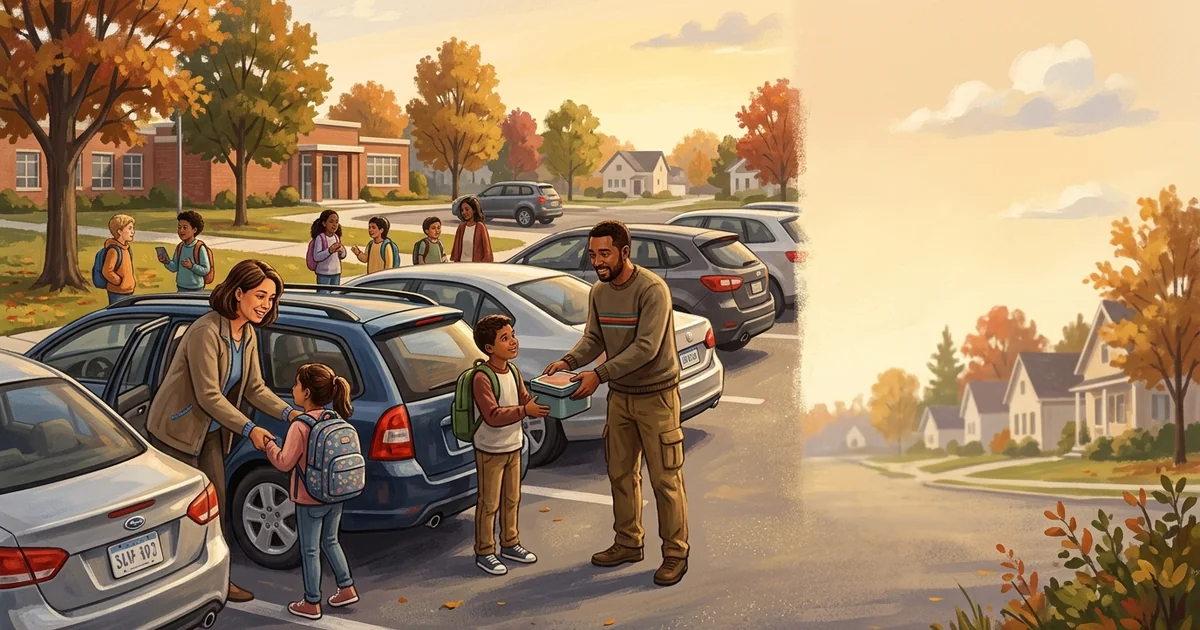
That's four and a half weeks of full-time work hours. Gone. Just to get a kid from one building to another and back.
This article is going to do the math. All of it — time, gas, wear, and the mental load that doesn't show up in any fuel cost calculator. And then we're going to show what happens to those numbers when you split the driving with even a small group of neighbors.
The Time Math: Where 180 Hours Comes From
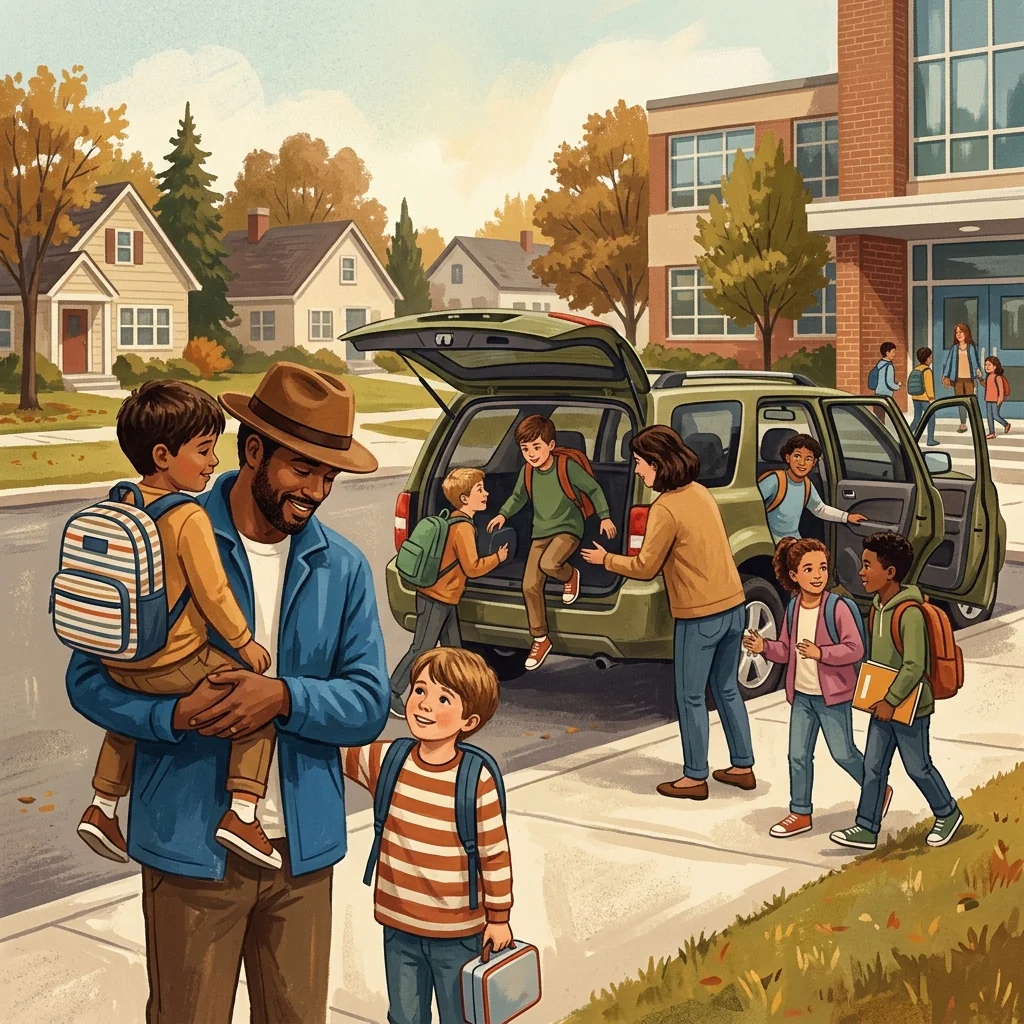
Let's build this up from first principles so the number is honest, not inflated.
Assumptions:- The average American public school is approximately 5 miles from home
- At typical suburban speeds (25–35 mph with traffic), that's roughly 15 minutes one way
- Round trip: 30 minutes
- But there are two trips per day: morning dropoff and afternoon pickup
- Total daily driving time: 60 minutes
That's the baseline. It assumes no traffic delays, no waiting in the pickup line, and a perfectly average 5-mile distance. If your school is farther away, or if afternoon pickup means sitting in a 15-minute queue, the real number is higher.
For families in suburban areas where schools are 8–10 miles away — not unusual in newer developments or when kids attend a magnet school across town — the number climbs toward 300 hours per year.
Putting 180 Hours in Context
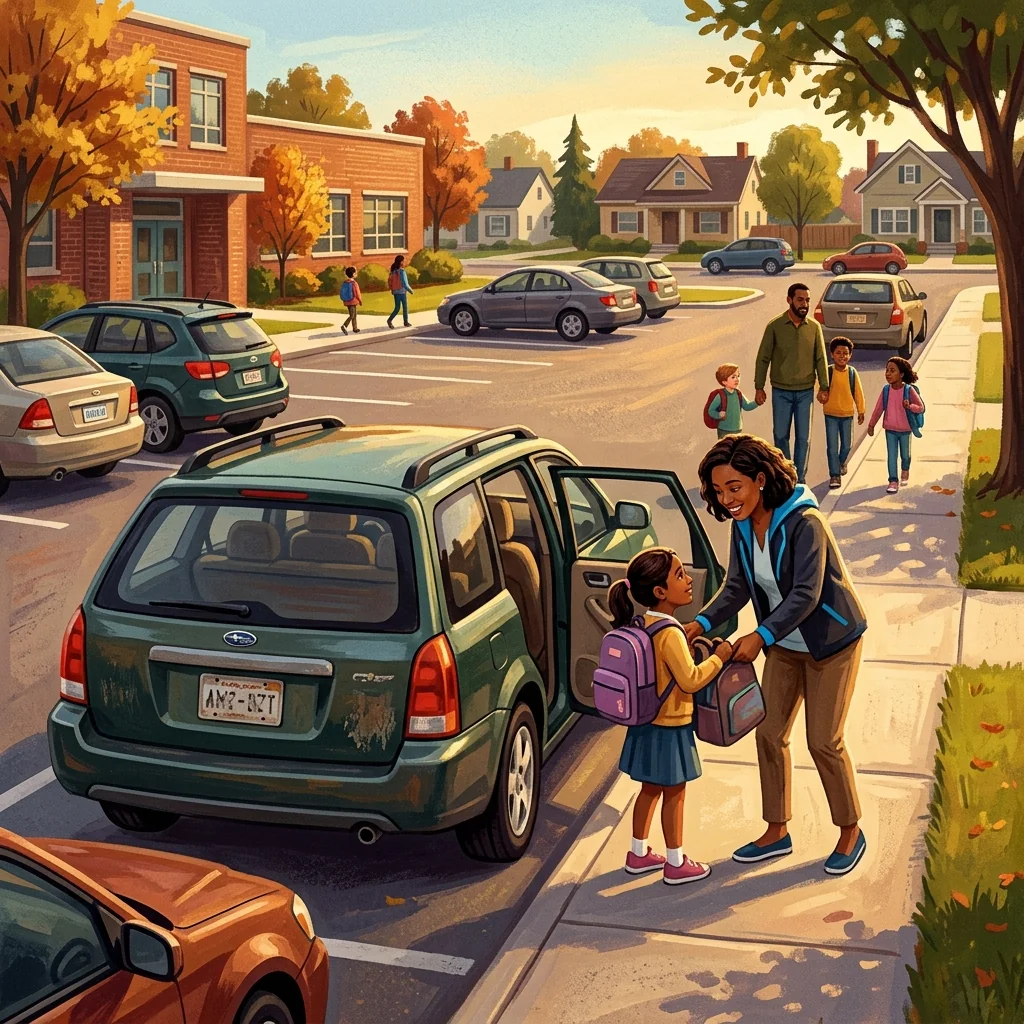
- 180 hours is 4.5 full work weeks at 40 hours/week
- It's the equivalent of a part-time job (roughly 3.5 hours/week year-round)
- It's more time than most people spend on any single hobby, exercise routine, or side project
- If you valued that time at minimum wage ($7.25/hour), it represents $1,305 in lost time
- If you valued it at the US median hourly wage ($34/hour), it represents $6,120 in lost time
The Gas Math: What Solo Driving Costs Per Year
Let's run the fuel calculation with current numbers.
Assumptions:- 5 miles to school, round trip = 10 miles per day
- Two trips (morning and afternoon) = 20 miles per school day
- 180 school days = 3,600 miles per year dedicated to school transportation
- Average US vehicle fuel economy: 28 mpg (slightly optimistic for a family SUV or minivan — the vehicles most school-run parents drive)
- Gas price: $3.20/gallon (national average as of early 2026)
If you drive an older SUV or minivan getting 22 mpg (very common in school carpool households), that climbs to $524 per year.
If gas returns to $4.00/gallon (as it did in 2022 and 2023), you're looking at $655/year at 22 mpg.
These numbers are per household, for a single child. For families with two kids at different schools, double it.
The Hidden Multiplier: Vehicle Wear
Fuel cost is the visible part. Vehicle depreciation and maintenance costs from miles driven are often larger.
The IRS standard mileage rate — a reasonable proxy for the full cost of driving a vehicle including depreciation, maintenance, tires, and insurance — is $0.67/mile as of 2025.
3,600 miles x $0.67 = $2,412 per year in true vehicle costs for school transportation alone.That's not a number most parents track. It shows up in an unexpected repair bill, a tire replacement, or the moment you sell the car and notice the odometer.
Year-Over-Year Cumulative Cost
One year of solo school driving: $2,412 in full vehicle costs. Elementary school alone is typically 6 years (K–5).
6 years x $2,412 = $14,472 in vehicle costs attributed to school transportation, before middle or high school.The Math on Carpooling: What Actually Changes

Now let's introduce a carpool. Four families, all in the same neighborhood, all going to the same school. You agree to a rotating schedule: each family drives one week out of every four.
Instead of driving 180 days per year, you drive 45 days per year.
Time Savings
Old schedule: 180 hours/year Carpool schedule: 45 hours/year (your driving weeks only) Time saved: 135 hours/yearThat's 135 hours you didn't spend in a car. Hours you can use for work, exercise, sleep, or just being present at home during the morning rush instead of stressed in traffic.
Over a 6-year elementary school span: 810 hours saved. That's 20 full work weeks. An entire academic semester's worth of time.
Fuel Savings
Old cost: $411–$524/year in fuel Carpool cost: $103–$131/year in fuel (your driving weeks) Fuel saved: ~$308–$393/year per familyIn your driving weeks, you do use slightly more fuel per trip because you're carrying 3–4 kids instead of 1–2. But the multiplier is small (maybe 5–8% more fuel consumption with extra passengers, not 4x). So the savings aren't a perfect 75% reduction, but they're very close.
Realistic annual fuel savings per family in a 4-family carpool: $280–$360/year.Full Vehicle Cost Savings
Old cost: $2,412/year Carpool cost: ~$620/year Vehicle savings: ~$1,792/year per familyOver 6 years of elementary school: $10,752 saved per family in vehicle operating costs.
That's money that doesn't leave your household. It's not a coupon or a rebate — it's a cost that simply doesn't occur.
Combined Value Per Year (4-Family Carpool)
| Category | Solo Driving | With Carpool | Annual Savings |
| Time (hours) | 180 hrs | 45 hrs | 135 hrs |
| Fuel cost | $468/yr avg | $117/yr avg | $351/yr |
| Full vehicle cost | $2,412/yr | $620/yr | $1,792/yr |
| Stress trips per year | 180 | 45 | 135 fewer days |
The Mental Load Cost (The One That Doesn't Fit in a Spreadsheet)
The time and money math is compelling. But parents who've made the switch from solo driving to carpooling consistently say the biggest change is one that doesn't show up in any cost calculator: mental load.
Solo school transportation isn't just the 60 minutes you spend in the car. It's:
- The constant scheduling constraint. Can't schedule anything during school pickup hours, every single weekday, for 9 months.
- The cognitive presence required. You have to be aware of the school calendar, early release days, holiday schedules, and bad weather delays — and personally adjust to all of them.
- The fallback problem. If you get sick, or stuck in a meeting, or have a flat tire, there's no one to call. You are the plan.
- The isolation of the task. It's one of the most time-consuming recurring tasks of parenting, and you're doing it entirely alone.
The mental relief of knowing that 75% of weekdays, pickup is handled by someone you trust — that's what carpool parents almost always mention first when asked why they do it. Not the gas savings. The breathing room.
What It Takes to Make the Math Work
The savings above are real, but they require a few things to be true:
1. The carpool needs to be reliable. If coordination fails and you end up driving on days that weren't yours, the savings evaporate. This is the biggest practical risk of carpool arrangements — not the idea, but the execution. 2. Someone needs to own the schedule. Carpools that run on group chats and informal agreements tend to drift. Someone eventually stops driving their fair share. Someone else quietly over-compensates. The arrangement falls apart. 3. Schedule conflicts need to be handled cleanly. Life happens. People need to swap shifts. The mechanism for doing that needs to be frictionless and visible to everyone.This is exactly what Carpool-Q is built to solve. A shared schedule that every parent can see and update in real time, with distributed locking so two parents can't accidentally overwrite each other's changes, and a clear record of who drove when. The logistics infrastructure that makes the savings actually materialize.
Frequently Asked Questions
What if I don't have four families nearby going to the same school? Even a two-family carpool — alternating weeks — cuts your driving days from 180 to 90 per year. That's 90 hours and roughly $900 in vehicle costs saved annually. The math scales with group size, but small groups still generate meaningful savings. Does carpooling work for different school start times? It can, but it requires more coordination. Some families manage carpools across two schools by staggering morning pickups. Others limit the carpool to after-school pickup only, where timing is more consistent. Start with whichever trip is more predictable and expand from there. What about families with only one car? One-car families often benefit most from carpooling, since every driving day they save is a day the car is available for other household needs. Being the "always receives a ride" family while contributing in other ways (hosting playdates, providing car seats for shared use days) can work if the group agrees on the arrangement. How do I find families to carpool with? The Carpool-Q app includes an invite system — send your neighbors a link and they join with a code. Most families start by reaching out to two or three parents they already know from school events or the neighborhood, then grow from there. Is carpooling really safe? How do I know who's driving my kids? Carpools are by definition small, known groups. You're not ridesharing with strangers — you're sharing driving with people you've chosen to trust. Most carpool groups develop their own informal norms quickly: text when en route, confirm pickup, let the other parents know if there's a delay.The Bottom Line
The cost of not carpooling isn't dramatic or sudden. It's a slow accumulation — 180 hours and $2,400 in vehicle costs per year, year after year, for a task that doesn't have to be entirely yours.
With even a small carpool group, most of that cost disappears. Three hundred fewer trips per year to school. Time that becomes available for other things. A schedule that has room for the unexpected. And a mental load that gets lighter every week it's not your turn to drive.
The math is clear. The logistics are the only remaining obstacle — and that's what Carpool-Q was built to handle.
Start your free carpool at carpoolq.com and see what 135 extra hours per year feels like.