If you've searched for a carpool app recently, you've probably landed on Carpool.School at some point. It looks polished. It shows up in results. And if you scroll past the homepage without clicking into the pricing page, you might assume it's designed for you — a parent trying to coordinate school pickups with a few families on your block.
It isn't. And once you see the pricing, that becomes very clear.
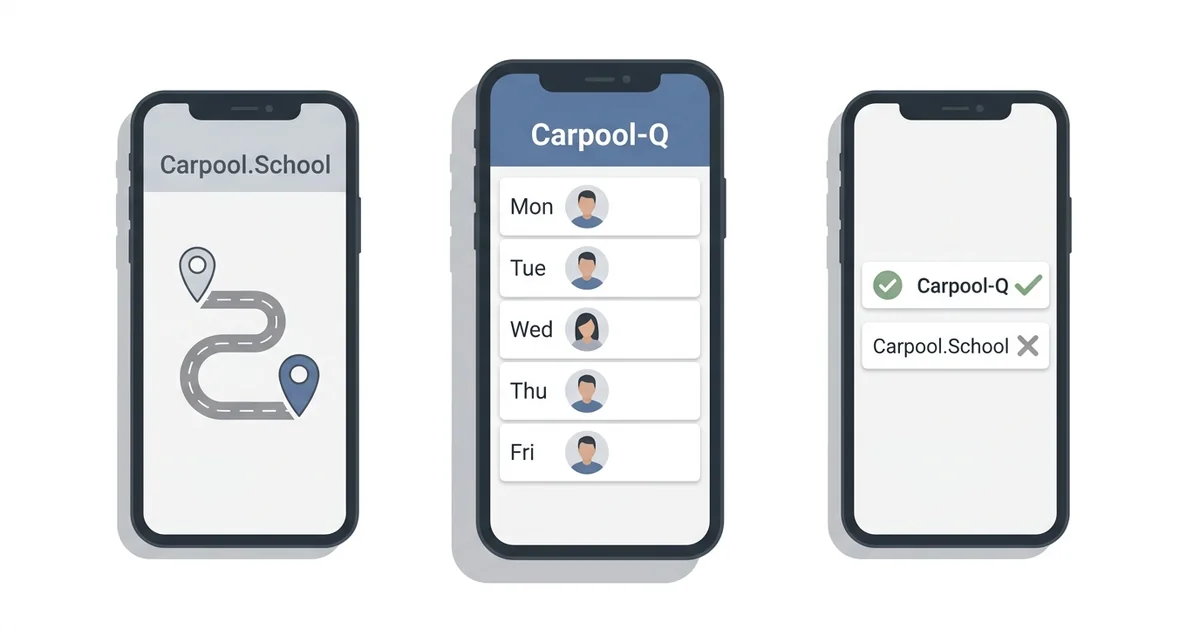
This article breaks down exactly what Carpool.School costs, who it's designed for, and what the actual alternative looks like for families who just want a simple, reliable way to manage a small carpool without enterprise overhead.
What Does Carpool.School Actually Cost?
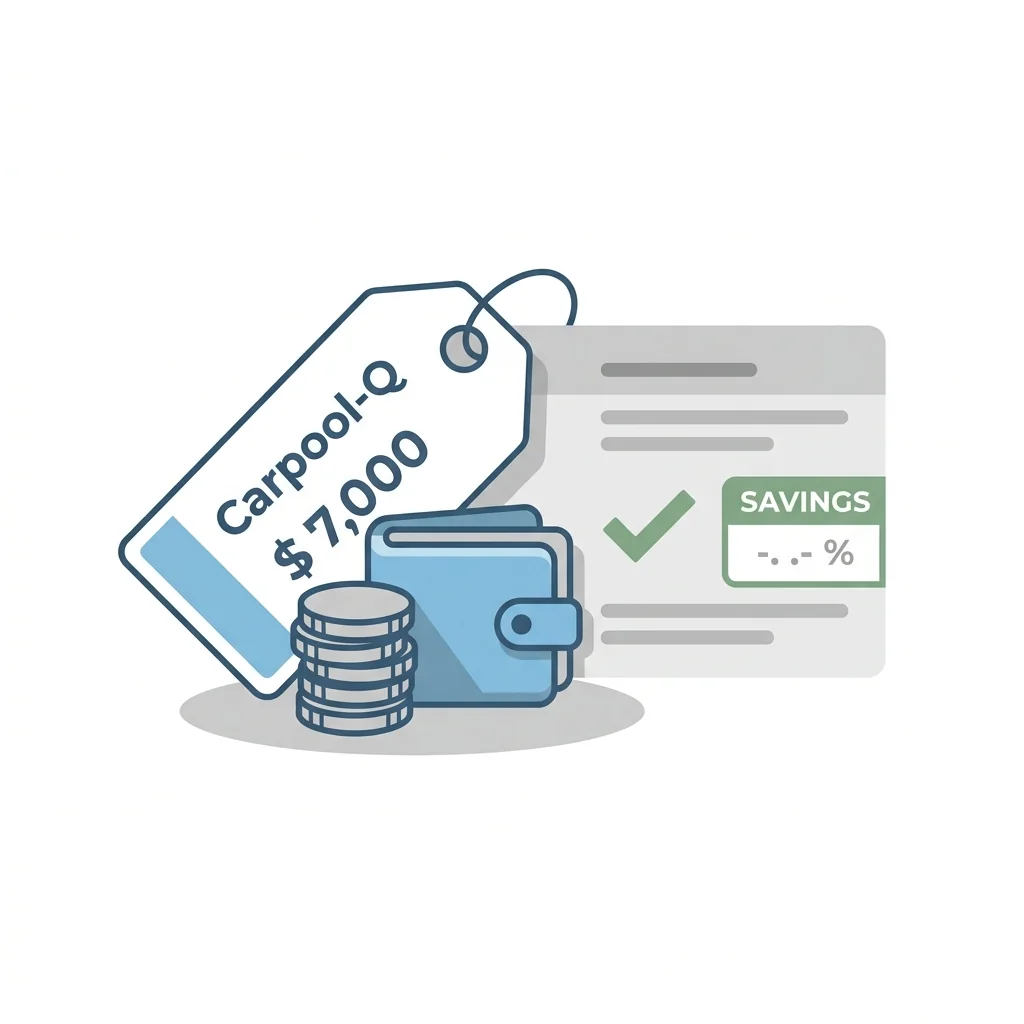
Carpool.School uses a per-user, per-month pricing model aimed at institutional buyers. Here's what the numbers look like in practice:
- Per-user pricing: approximately $2 per user per month
- Minimum user requirement: 100 users
- Effective monthly minimum: $200/month
- Annual plans: starting around $1,000/year for the entry tier
For an individual family trying to coordinate with three neighbors? You'd be paying $200/month for a platform built to serve 100+ people, using maybe 2% of its capacity.
What the Enterprise Tier Looks Like
At higher tiers, Carpool.School offers features like:
- School-wide carpool matching algorithms
- Admin dashboards for staff to oversee all carpools
- Parent communication tools built for mass announcements
- Integration hooks for school information systems
- Compliance and reporting features for district administrators
Who Carpool.School Is Actually Built For
Understanding Carpool.School's target customer explains everything about its pricing and feature set.
The buyer is not the parent. The buyer is a school administrator, a PTA board member with a budget, or a district IT coordinator. They're evaluating Carpool.School alongside other campus safety and logistics software. They have procurement processes. They sign annual contracts. $1,000/year is a rounding error in a school's technology budget. The users are many. When a school deploys Carpool.School, they're not setting up a carpool for 4 families. They're setting it up for 200 families across 40 different carpools, with staff oversight, route optimization, and parent-facing communication all managed through a single platform. The use case is institutional. Carpool.School solves problems like: "How do we match 300 parents who live in the same zip code into efficient carpools?" and "How does our front office monitor which students got picked up by which driver?" These are real problems. They're just not your problems.If you're a school administrator looking to implement a campus-wide carpool coordination program and you have a technology budget, Carpool.School is worth evaluating. It was built for you.
If you're a parent, it wasn't.
What Individual Families Actually Need
Let's be specific about what a typical family carpool actually requires.
The typical small carpool looks like this:- 3–6 families in the same neighborhood
- All going to the same school (or two schools at most)
- A rotating driver schedule based on who's available each week
- A need to swap shifts occasionally — reliably, without confusion
- Someone needs to be able to check "who's driving tomorrow" at 7am without calling anyone
- A shared weekly schedule that all parents can view
- The ability for any parent to update their availability
- Protection against conflicting edits
- A clear record of who drove when (for fairness)
- Push notifications when the schedule changes
- Works on mobile, no download required
The Feature Gap Is Not the Problem
It's worth noting that Carpool.School's enterprise features aren't bad — they're just irrelevant at small scale. The problem isn't that the tool has too many features; it's that the pricing model requires you to subsidize all those features even if you use none of them.
The $200/month floor exists because Carpool.School's infrastructure costs are spread across enterprise contracts. Small-scale users don't fit the model. There's no $10/month family plan because the economics don't work for them at that price — and honestly, the product isn't designed for that use case anyway.
A Side-by-Side Comparison
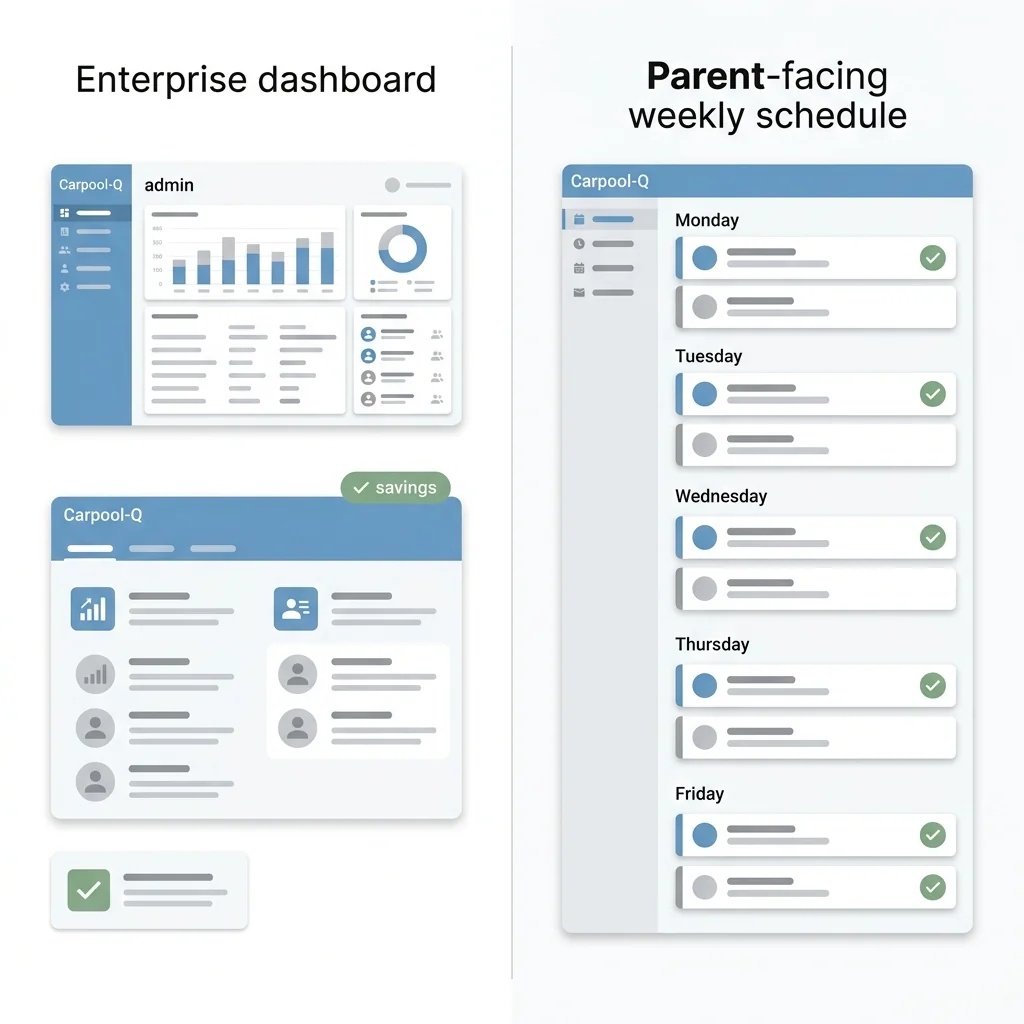
| Feature | Carpool.School | Carpool-Q |
| Target user | Schools, PTAs, districts | Individual families |
| Monthly cost | ~$200 minimum | $1.99/family/month (Premium) |
| Annual cost | ~$1,000+ | $0 free tier available |
| Minimum users | 100 | 1 |
| Real-time schedule editing | Yes | Yes |
| Conflict protection (locking) | Basic | Distributed locking |
| Admin dashboard | Yes (school staff) | Not needed |
| Carpool matching algorithm | Yes (school-wide) | Manual (you choose your group) |
| Mobile-friendly | Yes | Yes (PWA, no download needed) |
| Free tier | No | Yes (1 carpool) |
| Per-family pricing | No | Yes |
The Free Tier Question
One question that comes up frequently: are there free carpool apps for families?
Yes, with caveats.
Google Sheets / shared documents: Free, but no conflict protection, no notifications, no mobile-first experience. Works until it doesn't — and when it fails, it fails silently. Group chats (WhatsApp, iMessage): Free, but a chat thread is not a schedule. You end up with 47 messages to parse every time you want to know who's driving tomorrow. GoKid: Has a free tier with limited features. Primarily focused on ride matching and driver coordination, less on shared schedule management. Carpool-Q: Free tier supports one carpool with core features. Premium at $1.99/month per family adds unlimited carpools, driver reminders, shortage alerts, and priority support. No minimum user count. Cancel anytime.The free tier of Carpool-Q is designed to work for a single carpool indefinitely. If you have one neighborhood carpool and that's all you need, you may never have a reason to upgrade.
Why Pricing Models Matter More Than Feature Lists
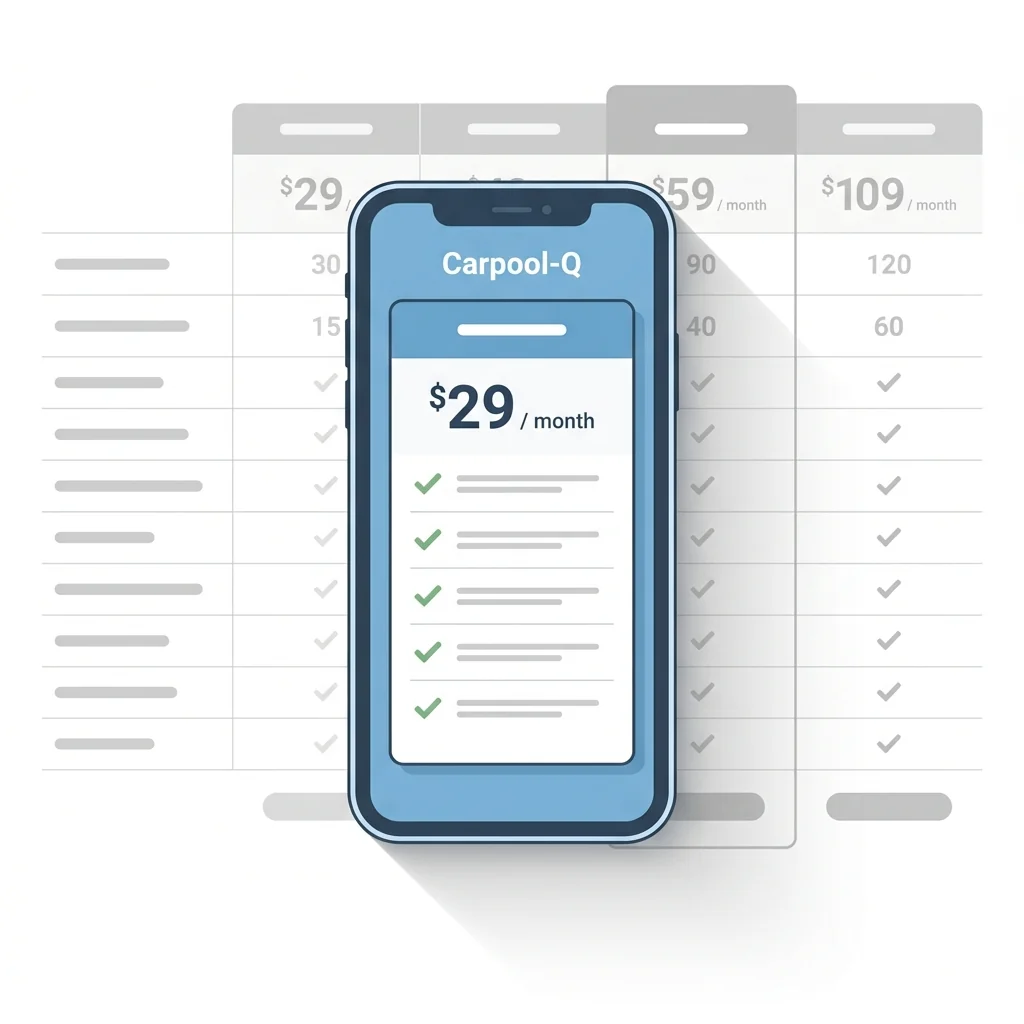
When you're evaluating apps, it's tempting to compare feature lists. App A has 12 features, App B has 8, App A wins. But pricing model often matters more than feature count, especially for small groups.
Per-user pricing with high minimums is designed to extract maximum value from large institutional buyers. It doesn't scale down gracefully. You can't buy 10% of an enterprise plan at 10% of the price — the minimum exists precisely because the economics only work at volume. Per-family flat pricing aligns costs with the actual unit of value for small carpools. A family is a family. Whether there are 2 kids in the carpool or 6, the family's coordination needs are roughly the same. Charging per family, not per individual user, reflects how people actually think about their carpool costs. Free tiers are meaningful only when the free tier is actually usable. A free tier that's so stripped down it's barely functional is just a trial period. A free tier that solves the core problem — managing one carpool, reliably, with real-time coordination — is genuinely useful.Frequently Asked Questions
Is Carpool.School free for parents? If your school has a paid institutional subscription, parents may be able to use it at no additional charge. But if you're looking to set up a carpool independently — not through your school's administration — there is no self-service free or low-cost tier available to individual families. Does Carpool.School work for a small group of 4–5 families? Technically yes, but you'd be paying the enterprise minimum of ~$200/month regardless of how many people you have. The platform also has a lot of complexity that isn't relevant at small scale. It's like renting a 20-passenger van to drive two kids to school. What's the difference between GoKid and Carpool.School? GoKid is primarily a consumer app focused on ride matching and parent communication. Carpool.School is an enterprise platform sold to schools and districts. They're targeting very different buyers. Neither is primarily focused on small-group schedule coordination with conflict protection. Why does Carpool-Q cost $1.99/month instead of being completely free? The free tier of Carpool-Q covers the core use case: one carpool, real-time schedule coordination, conflict-protected editing. Premium at $1.99/month adds features that require ongoing infrastructure costs — push notifications, driver shortage alerts, and support for families managing multiple carpools. The pricing is designed to be sustainable without charging enterprise prices to individual families. Can I try Carpool-Q before paying anything? Yes. The free tier isn't a time-limited trial — it's a permanent free plan for families with a single carpool. You only need to upgrade if you want premium features or need to manage more than one carpool.The Bottom Line
Carpool.School is a well-built product for the right customer: schools and districts that need to manage carpool logistics at scale, with administrative oversight, across hundreds of families. If you're a PTA coordinator or a school operations director, it's worth your evaluation.
If you're a parent trying to split school pickups with your neighbors, Carpool.School is the wrong tool at the wrong price. You'd be paying enterprise software rates for a problem that doesn't require enterprise software.
Carpool-Q was built specifically for families: flat per-family pricing, no user minimums, a free tier that actually works, and features designed around the real coordination problems small groups face — including real-time conflict protection so two parents editing the same slot at the same time don't silently overwrite each other. Start your free carpool at carpoolq.com — no credit card required.