When Meredith first texted her neighbor Lisa about sharing the school run, she was thinking about gas money and Tuesday afternoons. She had a work call that conflicted with pickup. Lisa had a daughter in the same class. The math was obvious.
What she wasn't thinking about — couldn't have predicted — was that two years later, when her father had a health emergency and she had to leave town on four hours' notice, the first person she called was Lisa. Not a close friend from college. Not a sibling across the country. Lisa, the woman she'd started talking to because they both needed to be in two places at 3:30pm on a Tuesday.
This is the part of carpooling that doesn't appear in any cost calculator. The time you save, the gas you don't buy, the miles you don't put on the car — those are real and measurable. But carpooling has a social return on investment that's harder to quantify and, for many families, ultimately more valuable than all of it.
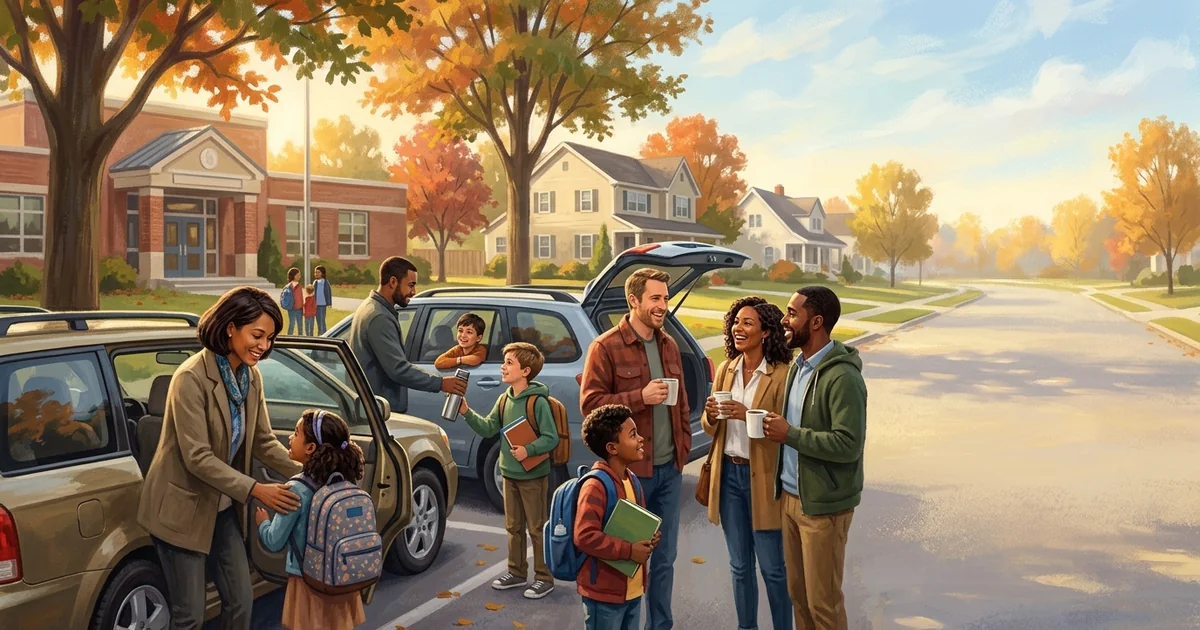
The Trust That Comes Before the Friendship
Let's be honest about something. Most carpooling relationships don't begin with deep trust. They begin with proximity and convenience.
You pick the family on your street because it's obvious. Or the parent you recognize from school pickup because you've made eye contact seventeen times without speaking. Or the family your kid mentioned because their daughter sits at the same lunch table.
You exchange numbers. You agree on a rough schedule. You try it for a couple of weeks.
And then something happens that's easy to overlook because it happens so gradually: you begin trusting someone with your child on a daily basis.
This isn't a small thing. Every morning when it's Lisa's turn to drive, Meredith is handing over responsibility for the most important person in her life to another adult. Lisa will buckle them in correctly. Lisa will watch for the distracted driver backing out of a driveway. Lisa will make sure her daughter walks into the building and doesn't wander off toward the playground.
That trust — established through repetition, through small consistent acts of showing up — is the foundation of a different kind of relationship than most adult friendships.
Most adult friendships are built around shared interests or shared history. Carpool relationships are built around shared stakes. Your kids matter to both of you. The arrangement only works if both of you are reliable. When it works — when you show up for each other week after week — the relationship quietly deepens.
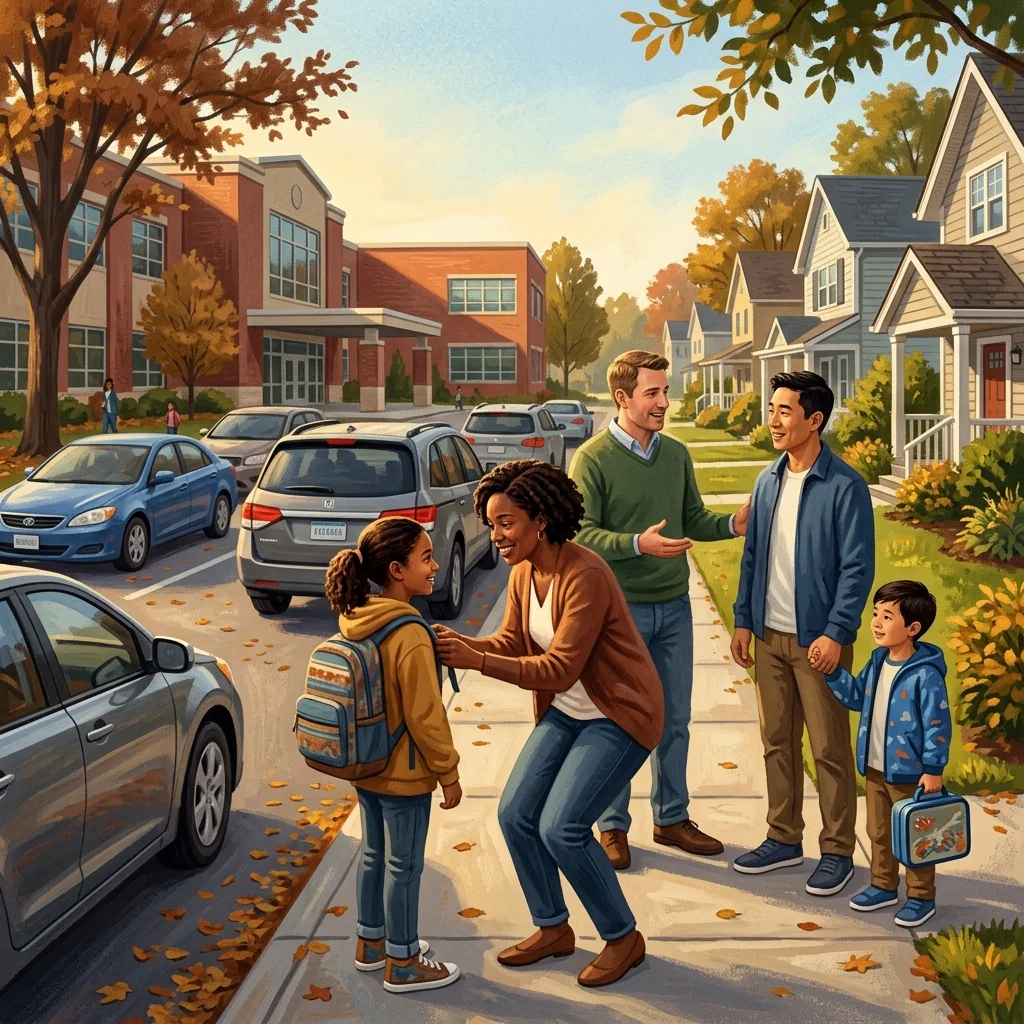
The Driveway Conversations Nobody Plans
There's a specific social dynamic that happens in carpool arrangements that's hard to manufacture anywhere else.
Call it the driveway conversation.
When you pull up to a neighbor's house to drop off or pick up kids, there's a natural 2–5 minute window. Kids are gathering backpacks. Someone forgot their water bottle. You're waiting for the front door to open. That window is long enough for a real exchange but short enough that it doesn't feel like an obligation.
You end up having conversations in those windows that you'd never have at a school event or a neighborhood gathering. Not because the setting is especially intimate, but because it's low-stakes and repeated. You see each other enough that small talk gives way to actual conversation, and actual conversation gives way to things that matter.
You learn that your neighbor is dealing with a difficult aging parent. You find out their family just got a diagnosis that's been weighing on them. You mention something you've been anxious about with your own kid, just offhandedly, because you're comfortable enough to — and the other parent says "us too," and suddenly you realize you're not alone in it.
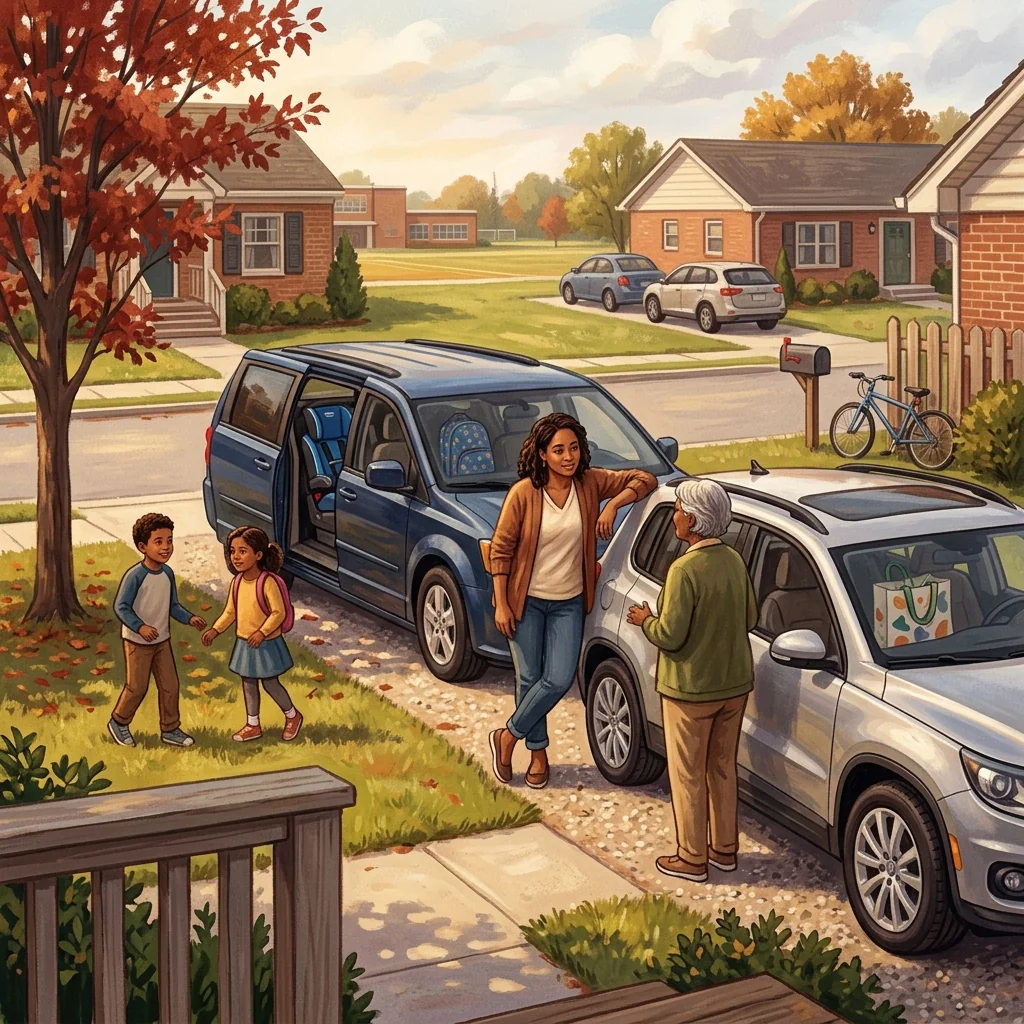
This is the mechanics of how community actually forms. Not through organized events or neighborhood apps or introductory potlucks — though those things help — but through repeated, low-pressure contact over time. Carpools create exactly that structure, five days a week, for the entire school year.
What the Research Says (and What Parents Already Know)
Social scientists who study community formation have documented what carpool parents often sense instinctively: frequency of contact is one of the strongest predictors of relationship depth, more so than intensity of interaction or shared interests.
Robert Putnam's foundational research on social capital, documented in Bowling Alone, found that the decline of casual neighborhood contact — the kind that happened naturally when people sat on front porches, walked to school, and bumped into each other during routine activities — was a primary driver of declining community connectedness in American life.
Carpooling is a structural antidote to that decline. It reintroduces regular, face-to-face, low-stakes contact between neighbors who otherwise have no reason to interact beyond a wave from the car.
The parents who feel it most acutely are often those who moved to a new neighborhood without an established social network. The carpool group, formed within the first few weeks of the school year, becomes the fastest path to feeling settled. Before you've been to a neighborhood barbecue, before you've met the other parents at a PTA meeting, you have a small circle of people you see every day and who've demonstrated — through showing up — that they're reliable.
That's not a small thing when you're new somewhere. It can be the whole thing.
When the Carpool Becomes the Safety Net
The most striking stories of carpooling-as-community aren't the ones about convenience. They're the ones about crisis.
Talk to parents who've been in carpool arrangements for more than a year, and you'll hear variations of the same story. A sudden illness. A family emergency. A moment when normal life was interrupted and everything needed to be covered at once — the kids, the school schedule, the logistics of a household in upheaval.
In those moments, the carpool group is often the first network to mobilize. Not because they were obligated to. Not because of a formal agreement. But because they'd already established the habit of showing up for each other's kids, and that habit extended naturally to a moment of real need.
Pickup covered. Check. Emergency contact name on file. Check. Someone to text at 6am who will actually respond. Check.
This is the "it takes a village" principle made concrete. The village isn't a collective of strangers who've signed up to help. It's a small group of people who've been showing up for each other in a small way, consistently, for long enough that larger support feels natural when it's needed.
The Kids Are Watching
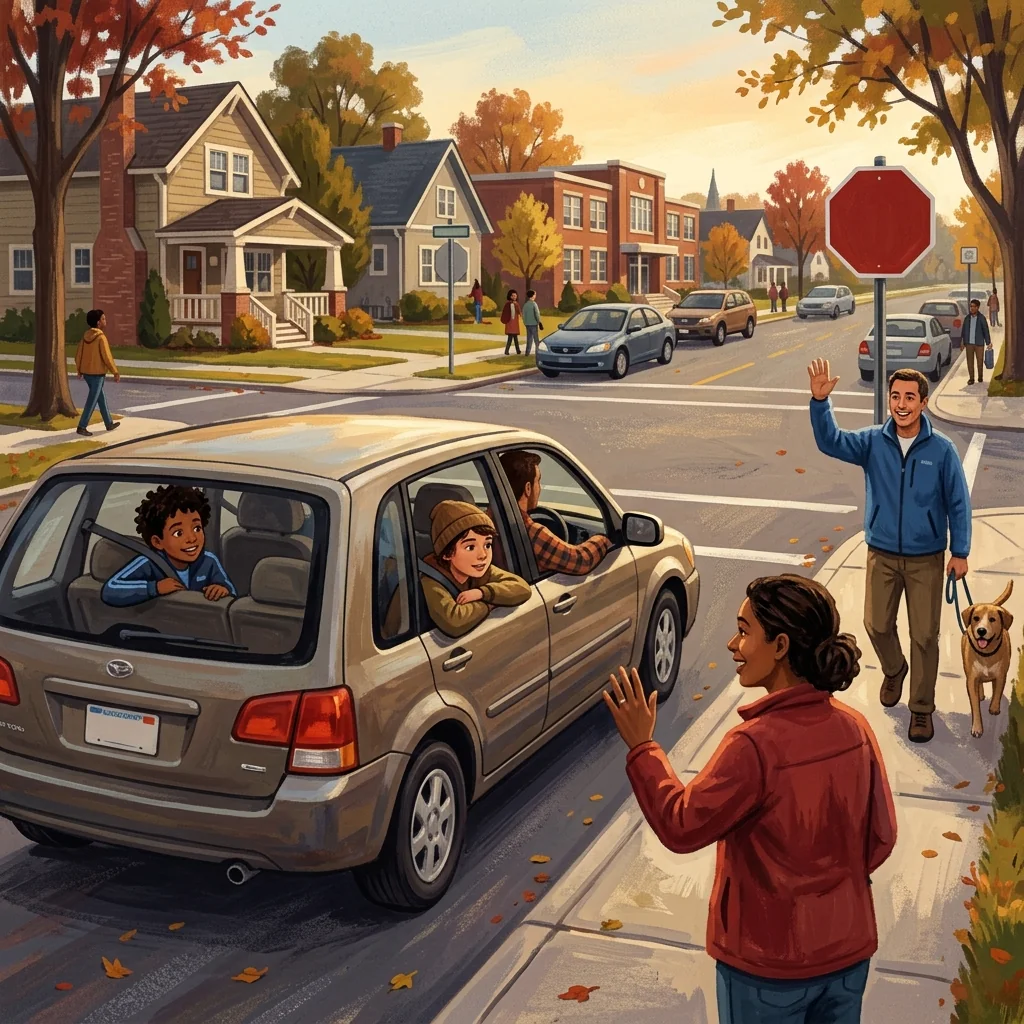
There's another dimension to this that parents often underestimate: what carpooling models for children.
Kids who grow up in carpool arrangements absorb something about how community works. They watch their parents coordinate, cover for each other, show up reliably, and navigate small conflicts — like the week someone forgot to drive and everyone had to scramble — with grace rather than resentment.
They also form their own relationships in the car. The 15-minute drive to school, the same kids every week, the contained space with no screens — this is, quietly, a remarkable social environment for children.
It's long enough for real conversation. Short enough to not overstay its welcome. Repeated often enough that kids develop genuine familiarity with each other. The backseat of a carpool on a Tuesday morning is where some kids have their most honest conversations of the week, precisely because it's not performative. It's just transit.
Friendships that form in carpool often outlast the carpool itself. Kids who rode together in elementary school remember it. Some of those connections persist into middle school, high school, and beyond. The shared experience of that routine — same car, same route, same Tuesday mornings — creates a kind of social history between kids that's different from classroom friendships.
Fairness as a Foundation for Trust
There's a less romantic but equally important aspect of carpool-as-community: fairness matters, and everyone knows it.
Carpools that work long-term have one thing in common: both parties feel the arrangement is equitable. Nobody is over-contributing. Nobody is consistently absent on their driving days. The load is genuinely shared.
Carpools that fall apart usually don't fail because of a single dramatic event. They fail because one family gradually drives less than their share, and the other family gradually absorbs more, and eventually the imbalance becomes resentment, and the conversation about it is awkward enough that the arrangement quietly dissolves instead.
This is why the logistics infrastructure of a carpool matters for the relationship, not just for the schedule. When it's easy to see who's been driving and when, easy to swap shifts fairly, and easy for everyone to stay informed, the foundation of trust that the relationship is built on stays solid.A carpool where one family can always point to a clear schedule and say "here's what we agreed to, and here's what actually happened" is a carpool where fairness is legible. Legible fairness prevents the slow drift toward resentment that ends otherwise good arrangements.
Starting the Carpool, Starting the Relationship
The first conversation is usually the hardest one. Even if you've waved to a neighbor a hundred times, suggesting a carpool is a step into a different kind of relationship — one with practical stakes and real interdependence.
A few things that make it easier:
Start with a limited trial. "Do you want to try swapping pickups on Tuesdays and Thursdays for a month and see how it goes?" is a much lower-commitment ask than "do you want to do a full carpool rotation for the rest of the year?" A trial period lets both families see if the logistics actually work before making a longer commitment. Be specific about the arrangement. Ambiguity breeds imbalance. Which days? Who covers which trip? What happens when someone is sick? What's the cancellation protocol? A five-minute conversation at the start about expectations prevents a five-month buildup of unspoken frustration. Use a shared tool. The fastest way to establish that the arrangement is equitable is to make the schedule visible to everyone. When both families can see the same calendar, no one has to rely on memory or trust that their interpretation of the arrangement matches the other family's. The transparency is the trust-builder. Give it enough time. The relationship takes a few weeks to develop. The first month is often a little awkward — you're calibrating schedules, figuring out each other's communication styles, learning that the other family does drop-off differently than you do. That awkwardness is normal and temporary. The families who make it through the first month almost always say the arrangement got easier and the relationship got better from there.Frequently Asked Questions
What if the carpool relationship turns out to be incompatible? It happens. Some families have different communication styles, different levels of reliability, or just different standards for pickup timing. The best outcome is an honest conversation early — "this isn't quite working for us, can we adjust?" Most of the time, a small adjustment fixes it. If it doesn't, it's okay to wind down the arrangement. Carpool relationships that don't work out don't have to become neighborhood conflicts if they're handled with directness and grace. How do you handle the relationship dynamics when there's a conflict? The same way you'd handle any conflict with a neighbor you value: address it early, be specific about what the issue is, assume good faith, and propose a solution. The carpool relationship is strong enough to survive a direct conversation about a schedule problem. What it doesn't survive well is a problem that festers unaddressed. What about families with very different schedules or work situations? Carpooling doesn't require identical schedules — it requires compatible ones. A family where one parent works from home and one is office-based might be a better carpool partner for morning-only or afternoon-only arrangements than for a full rotation. Flexibility in the structure of the arrangement expands who you can carpool with. Does carpooling work as well in neighborhoods where families don't know each other yet? Yes — and it's actually one of the best mechanisms for starting to know neighbors. A shared practical arrangement gives adults a reason to be in regular contact that feels natural and low-pressure. Many of the strongest neighborhood relationships form through exactly this kind of practical collaboration before they become genuine friendship. Is there a right number of families for a carpool? Two is workable and simple. Three or four is usually the sweet spot — enough people to spread the driving meaningfully, small enough that coordination stays easy and everyone feels the arrangement is fair. More than six families tends to get complicated, with scheduling conflicts multiplying and the schedule becoming harder to manage.The Unexpected Gift
Nobody starts a carpool because they want to build community. They start it because they need help on Tuesday afternoons and so does their neighbor.
But something accumulates in those Tuesday afternoons. In the driveway handoffs and the 7am texts and the "I've got your kid covered" on the day you couldn't make it. In the kids who grow up knowing what it looks like when adults show up for each other. In the quiet fact that you know, in a way you didn't before, that you're not doing this alone.
That's the unexpected gift of carpooling: it builds the kind of trust that only comes from repeated, reliable action. Not from a single grand gesture. From showing up, week after week, in a small and consistent way.
That's also how neighborhoods become communities. Not through events or apps or newsletters, but through the accumulated weight of small acts of showing up.
Ready to find your carpool community? Start with Carpool-Q at carpoolq.com — free to join, easy to coordinate.